


 In today’s fast-paced business world, supply chain agility and resilience have become more important than ever. To stay competitive, businesses need to optimize their operations and minimize costs, while also ensuring their customers receive the best possible service. Warehouse Management Systems (WMS) have emerged as a key tool for achieving these goals. By automating and streamlining warehouse processes, WMS solutions can increase efficiency, accuracy, and visibility across the supply chain.
But how do you convince the C-suite to invest in a WMS solution? That’s where our latest episode of the MHI Industry Leadership Podcast comes in. Our guests, Phil Hawbaker and Stan McLean from the MHI Solutions Community, share their insights on how to make a compelling business case for WMS to the C-suite. They discuss the benefits of implementing a WMS, including increased efficiency and accuracy, and offer strategies for calculating ROI and demonstrating the long-term value of a WMS investment.
Whether you’re a business owner, a supply chain professional, or simply curious about the latest trends and innovations in the industry, this episode is a must-listen. Tune in to the MHI Industry Leadership Podcast and learn how WMS solutions can help your organization thrive in today’s dynamic business environment.

Those tasked with preparing for the future of automation don’t have an easy path in front of them. Nevertheless, the innovation that developing robotic machines produce can be exciting. There are opportunities to grow and streamline many types of businesses. With streamlined control, disparate software challenges and maintenance hassles can fade away.
One of the best decisions a material environment can make is choosing vendors with the proper knowledge and perspective. In selecting vendors, it is important to try to choose ones who have a proactive, big-picture view. The temptation is to choose vendors whose expertise is deep in one area. Expertise about one piece of machinery, or a line of machines, can feel extremely valuable. However, this is often a short-term solution that provides limited long-term value. Expertise with the controls of only one line of machines fails to assist much in a long-term strategy.
Failing to choose vendors who hold an eagle-eye view of logistics, warehouses, and the drift toward automation and robotics has consequences. Without foresight, a COO can end up trying to reassess and renovate their software and machinery situation every few years. Expanding possibilities for robotic integration should be the priority.
Having a ten or fifteen-year perspective and level of proactivity saves effort. A long-term decision is to value and implement an agnostic software solution. A comprehensive WCS can ensure a business is not limited by past investments to old machinery and the associated software. Old software that is unlinked will hold back the possibilities for streamlining and automation. Warehouse operations, distribution centers, and large corporations with warehouses that plan for the future will reap the benefits.
In business, having great vision and a clear direction are invaluable skills. Warehousing and logistics are no different. On a large and small scale, focusing on growth and optimization is invaluable. When each item, package, or pallet flows toward its ultimate destination sooner, the streams of small actions add up.
To help create a current of efficiency, vendors who speak the languages of logistics, technology and business make the best partners. When a vendor understands overall operations, the need to constantly explain dissipates. Operators won’t need to brainstorm workarounds resulting from vendors’ lack of understanding. Cobbling together solutions isn’t necessary. Solutions providers who think long-term and are already acquainted with your pain points help operators develop and execute a strategy for proactive, long-term success with fewer adjustments.
Choose machinery with the future in mind. For each specific task, the appropriate, best-fit machine makes a world of difference. If an AS/RS serves the objectives better, settling for three carousels is not worthwhile. Creating a future-focused plan hospitable to robotics, and prioritizing machinery that fits within that plan, can pay off.
One area where robotic solutions are advancing rapidly is for clearly defined tasks. Having robots complete simple, discrete tasks can be wise. The machines ceding tasks to robotic machines at present are conveyors. While conveyors bolted to the floor provide limited movement of goods, agile robots will prove useful for movement-based tasks. It is easy to imagine that by using sensors, they become capable of more efficient movement. By multiplying this agility beyond the limited movement of conveyors, much more efficiency becomes possible.
Robotics machines are usually packaged with OEM software. This OEM-supply WCS is limited in many cases. Integrating them into a broad software solution in warehouses on a wider scale can be challenging, yet may produce quality results.
Autonomous mobile robots (AMRs) used for transportation have proven to be a great addition to an overall solution for warehouses. They can work with automated storage devices. However, they’re not capable of interfacing to the certain carousels. Two separate WCSs create unneeded steps and clutter in terms of the volume of software needed. The need to manage and maintain that software piles on extra layers of complexity.
As robotics progress beyond AMRs to those capable of more complex tasks, using one comprehensive warehouse control system software will become increasingly important. Presently, robots completing discrete actions or traveling between points don’t need to communicate with other machines often. As the possibilities for robotics develop, an OEM WCS’s limits would become apparent. For example, the possibility of gamifying the warehouse with augmented reality could make warehouse operations more efficient. The control system from a robotics or carousel manufacturer can’t be expected to control the interface to the user. An agnostic, high-level WCS would shine in managing more developed robotics, along with more classic machines like carousels.
The prohibitive nature of OEM warehouse control systems not having a robust database is a concern. That is especially the case when trying to plan a road map for warehousing or distribution. Typically, the limited database of OEM software will slow down the progression toward the business’s goals in the future. Avoiding decisions or maintenance of systems that will not scale with discrete should be a priority. In fact, by not controlling the machines from a high, informed level and letting them work together, the business is not maximizing its investment in the machines. Nor is software providing a good return on the investment. By controlling through a higher level, more informed warehouse control system software, unprecedented cohesion becomes possible.
Taking a bird’s eye, long-term view for ten years is key to making the correct decisions for warehouse control system software. Synchronizing the road map between vendors and other partners will help the business advance toward its goals. Crafting an automation roadmap with scalable software that is financially modular is the best option. A comprehensive WCS designed to be modular and priced according to the currently needed modules can make the difference. As needs change, scaling up within the next month should be possible. Growing with modules of software is easier than adapting to new software packages.
The future of robotic integration into the material-handling world is exciting. With foresight and a well-formulated strategy for software and machinery cohesion, efficiency can soar. High-level warehouse control system software can propel businesses further. Businesses relying on many separate WCSs that came with the machinery will need to keep maintaining them. They’ll need to keep dealing with their limitations and the inefficiency of a disjointed web of disparate software. Meanwhile, those using a streamlined WCS solution will do more with less software. They can push warehouse operations further, faster.

Some of the abilities of a programmable logic controller are similar to those of a warehouse control system software. However, they are too limited in volume of commands. Lacking a database, a PLC can only be directed for a limited number of actions. Meanwhile, a centralized WCS can feed information to devices more slowly, on a time-dependent basis. A PLC cannot meter commands like a WCS. It cannot store many commands because the database is too small.
A centralized WCS has more human-like intelligence that can orchestrate different machines simultaneously throughout a daily cycle by gathering and metering more real-time information. A WCS has this capacity due to its database size.
With a centralized, agnostic warehouse control system software, the need for separate WMS and WES lessens. Warehouse stock control software can be an involved task to implement. The best solution is a comprehensive package. A business can buy a package performing all three functions. Better yet, it can be a modular package. Components could be added as new needs arise. A modular WCS would be suited to the diverse needs of a distribution environment, a manufacturing environment or a corporation’s warehouse. Beyond being adaptable to the type of center, a modular WCS can scale as the business develops.
With modular options, the software expenditure can become commensurate with business needs. Why should a company pay for a comprehensive software solution when it only uses 70% of it? That vendor is over-solving their client’s software problems and needs. In effect, they are charging for unused functionality.
When weighing options for improving control and leverage over automated equipment, many people consider ERP-based options. They think the best route would be to start moving into unused portions of their existing ERP. Many operators believe their existing ERP has additional functionality for automation that could be useful or consider upgrading it. However, an ERP is often lacking in quality warehouse control system software.
A simple WCS connected to an ERP may produce narrow results. When a WMS is involved with the ERP, the information delivered is broader. It’s not limited by what is stored in that device.
The flow of data and commands between warehouse control system software to different locations varies depending on the type of connection. When it flows down to a device, time is a priority. Meanwhile, when interfacing to an ERP, time is not of the essence.
An advantage of warehouse control system software sending a command to a device is that a response can return immediately. The device can quickly affirm when it will complete the task. This can happen on the scale of a millisecond. It happens in real time, using a web service, a web API or a TCP/IP interface. Faster response times keep many types of actions moving forward in a distribution center or warehouse. Databases don’t allow for a real-time interface.
When interfacing to an ERP, real-time interactions are not a priority. An ERP system doesn’t care when the designated action occurs. It could take place in the next 30 seconds or five minutes later. When a WCS interfaces to a device, time is a priority. The result is that a WCS provides the level of necessary responsiveness. An ERP isn’t as sensitive to time.
It’s important to consider whether warehouse control system software or its components should reside in the cloud. Guaranteeing responsiveness is a vital part of location considerations. Those with experience in WCS operations warn of the challenges of securing real-time interface to that piece of machinery. There are instances when dark fiber can guarantee a high level of response. In that case, a WCS that resides in the cloud can work well. However, guaranteeing real-time response with cloud-hosted databases remains a major challenge for a lot of companies.
In many cases, some components end up being housed in the cloud, while others remain local. This hybrid situation can keep operations running smoothly. Components that do not depend on a sensitive, millisecond response time can be stored in the cloud. Meanwhile, on-premises machinery interfaces can better guarantee the faster travel of information. Speed is the key.

Warehouse control system software can automate and command devices and machinery in innovative ways. As robotics advance, moving toward a more cohesive control structure can yield streamlined, efficient results. Machines controlled by a comprehensive (WCS) warehouse control system include storage devices like an automated storage and retrieval system. Vertical lift modules and similar machines could also be operated by a WCS. Many other devices in warehouse and distribution center environments can be automated and optimized by warehouse control system software.
A comprehensive WCS can not only control the machines’ function but operate in real time. The real-time capacity of broad warehouse control systems offers more sensitivity to current warehouse needs. With real-time information, each decision can be made from a more informed standpoint. The result for a warehouse with WCS is better, faster decisions. The ultimate outcome of more informed commands and actions is getting material where it needs to go faster.
A comprehensive WCS, (warehouse control system) can interface with many types of machinery. These include vertical or horizontal carousels. It also interfaces with conveyor systems and sortation systems. Pick-to-light and put-to-light systems that give order pickers clear instructions can also be controlled by a WCS. As automation and robotics evolve, a high-level WCS can reduce disjointed situations in warehouses. Many types of machines, including robotic ones, can be controlled to work in harmony.
A machine in a warehouse needs commands to operate. Of course, in the past, a human would direct the machine. Control through a WCS provides an opportunity to remove human labor resources. This solution can combat labor shortages and scheduling difficulties. A WCS can manage and automate the activities of a machine. The person or the few people controlling a broad WCS have more leverage over the machines operating in a warehouse or distribution center.
A WCS can talk to other business systems. Enterprise research planning (ERP) software like Oracle can interface with it. A WCS can communicate with a warehouse management system (WMS) that helps with the flow of inventory and goods. Typically, it lives in the middle of the architecture. It communicates at different speeds to different partner software and controls like warehouse inventory control system software.
One advantage of comprehensive warehouse control software is the options provided by the database. Machine controls can’t usually handle large databases. A WCS offers the functionality to connect with a database. It can also integrate data from an ERP system and parses the data into simpler commands the controls can digest.
From the central location in the architecture, the WCS controls the equipment. Since it can process real-time data, its commands flow from the warehouse’s overall needs at that moment. The tasks are carried out by the machines within an optimized timeframe and with optimized speed. The reduced interval of time from task creation to successful task completion is crucial. Real-time data and faster execution make a big difference.
Automation equipment is frequently packaged with a warehouse control system. Although the equipment has controls, they are situated at too low of a level. They only operate that individual machine. For example, a vertical lift module’s WCS may not talk to a carousel’s WCS. Warehouse operators are not getting much more leverage over the machines. A centralized WCS can optimize, connect, and process more systems. It is agnostic, meaning it can control many different machines.
A WCS can sometimes integrate to an ERP. However, in most cases, there are massive differences in coding structures. Integration isn’t practical, and it’s not often worth the effort of integration.
The scope of warehouse control system software applications can vary widely. Some arrive with and solely work with the machinery, while others can control any type of machinery. A vertical lift module with a WCS from a manufacturer cannot communicate with a vertical carousel’s distinct WCS. The result is two islands of non-communicative software. A high-level WCS could control both. It synthesizes operations in a warehouse or distribution center.
When improved streamlining and coordination is feasible, it provides a higher return on investment. It’s more feasible to benefit from investments in machinery, software and personnel. The expertise of operators stays shallower when there are many software packages. Employees working in fewer warehouse control systems have more time and incentive to learn and remember details and quirks.
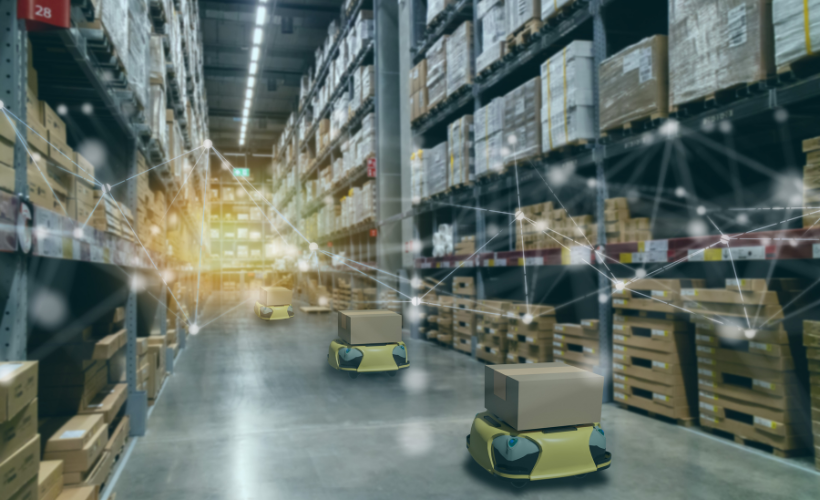
Warehouse robots are increasingly essential in retail, distribution, and manufacturing environments. For years now, robots have been used for single, discreet warehouse tasks. Today, however, robots are being implemented for more and more complex warehouse operations. This increased demand is being driven by multiple factors, including accelerating e-commerce growth, pressure from consumers for faster turnaround on orders, and growing competition for labor.
Could warehouse robots improve your operations and overall performance? Do you know which warehouse automation solutions are optimal for your business?
Here are the key factors to consider before adding robots to your warehouse:
Warehouse robots come in a variety of types, with different capabilities and features
When it comes to warehouse control systems, robots are just another form of automation. That means you are likely already familiar with some types of warehouse robots, while others may be completely new to you. It is important to understand how warehouse automation has evolved and the wide array of features and capabilities now available.
Types of warehouse automation
Both GTP and shuttle systems can involve machine learning and artificial intelligence (AI) capabilities. This technology now ranges from simple software and autonomous functionality to much more advanced systems with complex sensors and sophisticated predictive analytics.
For example, autonomous mobile robots (AMRs) are gaining traction across a range of distribution environments. Simple AMRs can be programmed and implemented quickly, without a lot of overhead, to accomplish repetitive tasks, such as moving product from one location to another.
Articulating pick robots are also becoming more popular. These robots have the intelligence to discern among mixed products in a single bin, cart, or tote. An articulating pick robot is smart enough to recognize a wanted item, find it, and then move its arm to pick the item. Some can even distinguish damaged items and reject them. When equipped with machine learning, these robots learn about the product base and how best to fulfill orders, and they improve over time.
Understanding the scope of features and capabilities currently available can help you find the warehouse automation solution that will be most useful in your warehouse.
Determining the “why” is critical
It is crucial to identify the specific role robots will play in improving the operation of your facility. Generally speaking, the top reasons companies opt for warehouse automation are to:
Calculating the ROI of warehouse robots
While evaluating options, be sure to calculate the return on investment (ROI) of different warehouse automation types. First, identify warehouse operations that involve demonstrable, repetitive tasks and determine the hard costs associated them. Then, compare that to the cost of buying or leasing a robot that could assume those responsibilities.
For instance, simple time-and-motion studies of warehouse associates have found 60% of their time is spent walking. Buying or leasing AMRs or other type of warehouse robot can dramatically reduce or eliminate that walking time and result in significant labor cost savings. Warehouse robots can also help businesses adjust to peak season surges and dips.
Robots must be integrated with warehouse processes
To be effective, warehouse robots must be integrated with other warehouse processes. Remember: Warehouse automation is not meant to function as standalone technology. Instead, it needs to be connected to other automation and warehouse processes.
Working with an experienced warehouse automation provider will help you avoid creating islands of robot technology. That’s why it is so important to look for a warehouse robot vendor that can combine warehouse management (WMS), warehouse execution (WES), and warehouse control systems (WCS) into a single package.
The goal is to improve warehouse productivity using technologies that can blend with your current warehouse operations. Ultimately, that solution could involve AMRs, an automated storage conveyance system, pick by light, or another type of warehouse robot. The right vendor will deliver a complete solution that seamlessly integrates today’s automation technology to optimize results.


A true Warehouse Management System (WMS), when it’s not a bolt-on module, is the foundation for inventory management within a warehouse. It controls all inventory operations, including tracking, expiration date tracking, and numerous other details that an ERP would be hard pressed to keep track of with large scale inventories of 100,000—200,000 items.
A warehouse control system (WCS) is a software package that not only manages some forms of WMS functionality, but also controls automation equipment within that same environment. In other words, a WCS controls, directs, and manages vertical carousels, vertical lift modules (VLMs), horizontal carousels, conveyor systems, sortation systems, autonomous guided vehicles (AGV), automated storage and retrieval systems (ASRS), goods to person (G2P), pick by light, put by light (i.e., put wall), hands free picking, robotic picking, and more.
A WCS interfacing with all these different technologies can sound quite complicated, but the level of complexity depends on the type of automation equipment under control and the capabilities the WCS. In fact, for most horizontal carousels, vertical carousels, and vertical lift modules (VLM), the WCS can be relatively straightforward. Other technological solutions, such as those involving robots, AGVs, and MDR conveyor systems, typically introduce more complexity.
A warehouse execution system (WES) is analogous to a task manager; it will execute on a specific task, but it can do tasks from the WMS and it can do tasks from the WCS. Some call it a “WMS lite.” A WES has some, but not have all, of the capabilities of a WMS.
Our WCS software capabilities interface directly with the underlying PLC-based controls so an extra OEM software system or integration point to communicate to automation PLCs is not required. This eliminates an entire layer of software complexity across a warehouse operation. A WCS can be considered the brains or the intelligence of the automation as opposed to the direct control of equipment. The underlying PLC machine controls execute the decisions dictated by the WCS or WES.
What type of operator training is required for WMS with WCS?
Operators do not need training on the software programs for the automation included in the WCS. From the user perspective, all WCS functioning happens in the background. Maintenance personnel will need to know how to service and maintain the different automated systems, but warehouse operators will only see the end result—e.g., that the carousel has spun and that the light bar is indicating the product that needs to be picked.

Today’s software-based warehouse management system, WMSs often include warehouse control systems (WCSs) that are able to integrate with automated storage options such as conveyors, vertical carousels, or VLMs.
As a result, products stored in carousels can be delivered to pickers, who simply scan barcodes to record the warehouse picking process. That data then goes directly to the ERP. On their own, ERPs cannot integrate with or automate the hardware. WMS can also integrate with a WCS to support voice picking, pick to light, and print and apply.
How does a WMS support shipping?
The WMS communicates with both the ERP and the shipping module that is post-pick. This is a simple integration offering improved accuracy, efficiency, and convenience. Essentially, every time that a product is shipped to a customer, the tracking number goes into the transactions that go to the ERP. Then, the ERP can invoice the customer including the tracking number.
When is it time to consider moving from a paper-based system to a WMS?
Warehouse managers should consider moving from a paper-based system to a WMS as soon as they detect issues with shipping speed and accuracy. If throughput is not keeping up with demand, a WMS can help. Typically, problems with speed and accuracy are reflected in higher labor costs. For example, if a warehouse is experiencing a lot of overtime, the reasons could be related to issues with speed and accuracy. A WMS can improve processes so operators can work more efficiently. Finally, a WMS can help warehouse managers optimize storage density and maximize warehouse space.
What type of reporting is best for a warehouse?
Relying on ERP for reporting can be problematic because the ERP is not on the operations floor and does not function in real-time. That means there is always going to be lag time between what is really happening on the warehouse floor and what is being reported that is happening. By contrast, a WMS operates in real-time at the warehouse and presents a truly accurate account of inventory. If a warehouse manager needs real-time reporting on their operation, they need a software based WMS.
How does an advanced WMS platform generate reports?
A WMS can report on virtually all warehouse operations, ranging from receiving, inventory, and order picking to shipping and consolidation. Reports can also be more specific, such as put aways that have been entered into the system that haven’t been completed, replenishments that haven’t been fulfilled, etc. With a software based WMS, all of these reports can be generated in real-time. ERP systems cannot provide reports like these because ERPs lack real-time information and the ability to customize reports.
Why is a WMS better at handling an emergency situation such as an expedited order?
When a customer needs an order “right away,” a WMS can immediately make the appropriate adjustments to inventory and picking schedules. This is called hot picking. It is much more difficult to fulfill expedited orders and maintain accurate inventory records with a paper-based system. A WMS can also easily handle cross dock, returns, and other complex warehouse operations that are too complex for paper-based or ERP systems.

Yes, manual warehouse operations can be ERP based; however, a variety of different problems can arise in these situations, particularly in large warehouse environments. For instance, when the lead or the manager uses printed paperwork to determine picking schedules, it can be difficult to keep all of the data straight and pages may get lost or misplaced along the way. Overstocks can also be problematic.
When a receiver cannot fit all of a product in one location, they need to find another place to store the remainder. If the location information or the quantity that was put in each location is wrong, or written down incorrectly or illegibly, then problems can arise. Since ERP does not offer real-time transaction data, any changes to what is in storage—either because of overstocks or picking—are not accounted for in real-time.
How does ERP handle batch picking, zone picking, and wave picking?
ERPs can have difficulty handling complex picking processes. For example, when there are waves, the first bundle of orders is generally picked and distributed first, before the second wave comes. However, in an ERP-based system, the information is not recorded in real-time. In many cases there is an operator sitting at a desk recording data on every order. That means there are two people—the picker and the person entering the data—involved with each order, and the warehouse manager may not be sure who, if either, is correct. If the picker is supposed to pick 10, but mistakenly only picked nine, but the paperwork says 10, the data entry person enters it as 10. The inventory won’t reconcile, and the customer is shorted. On the other hand, if the picker mistakenly picks 11 instead of 10, the warehouse loses money.
What is slotting and how is it associated with picking speed?
Slotting is the practical application of a statistical analysis for the SKU/product base in a warehouse distribution center or manufacturing facility. It consists of reviewing and analyzing the velocity or movement of items and associated cubic storage movement of those items relative to the other items. The goal is to determine optimal locations to store items and also make decisions about optimized automation systems to store and manage those items. Primarily, slotting improves labor, travel time and automation efficiency. The secondary by-product improvement is space utilization. A slotting analysis can help determine if a business is out of space or consuming too much space. If a business slots correctly and automates correctly, the footprint can often be significantly reduced.
A slotting analysis is based on the cubic dimensions of items, as well as their current and projected velocity. Velocity equates to the requisite travel time for an operator to pick the item over a given period of time. That means that the velocity of an item picked 1,000 times a month is much higher than the velocity of an item picked once a month. Velocity directly correlates to operator labor and travel time either in a non-automated environment or in an automated environment. It could be the wait or dwell time of the automation equipment for that particular item. Conducting a slotting analysis and making decisions about how to optimally slot items in the facility improves productivity substantially. Slotting analysis helps determine what type of automation equipment to use and generates the underlying ROI for re-slotting and/or automating the storage of any given set of SKUs or products.
The average warehouse associate spends 60% of their time traveling. In a warehouse that is properly slotted, travel time can be significantly reduced and that, in turn, lowers labor costs. Slotting can also increase the efficiency of automated storage equipment. In fact, all the dynamics of a warehouse can benefit from a slotting analysis since it improves average warehouse throughput, productivity by piece of equipment, productivity by picker, order turn-around time, and overall throughput to meet peak demands.
What is the difference between manual warehouse operations with an ERP and using an ERP with a WMS?
With a software-based WMS, operators use hand-held devices to do the inventory management and accounting. As soon as the operator hits “enter” on the device, that transaction is created and on the next iteration of communication with the ERP, the data is sent. This combination of WMS and ERP offers real-time inventory management, informing warehouse managers about exactly what happened and when. It’s much more efficient, faster, and more accurate than paper-based systems.